You are here
Krebs on Security
ShinyHunters Extorted Boeing Spin-off Prior to Arrests
A teenager from Amman, Jordan suspected of leading the prolific data theft and extortion group ShinyHunters has been detained and is reportedly cooperating with the FBI to identify other members of the hacking gang. KrebsOnSecurity has learned that the suspect, who uses the hacker handle “Rey,” was detained as ShinyHunters was in the process of extorting a business unit recently divested by the global aerospace company Boeing, which manufactures the fleet of planes used by the employer of Rey’s father — Royal Jordanian Airlines.

The logo for Jeppesen ForeFlight, a business unit divested last year by the aerospace firm Boeing.
On October 3, Reuters cited three unnamed sources saying a suspected ShinyHunters member in Amman named Saif Al-din Khader was detained by Jordanian authorities and was cooperating with the FBI. KrebsOnSecurity identified Rey as Khader in a November 2025 profile, in which the young man admitted working with multiple ransomware groups.
Rey was featured again in a September 28 exclusive about the Dutch police arresting 24-year-old convicted cybercriminal Pepijn van der Stap on suspicion of aiding in data thefts and extortions by ShinyHunters. The story noted that immediately following the Dutchman’s arrest on the evening of September 15, Rey assumed control over the ShinyHunters brand and boasted publicly about stealing highly sensitive data from the FBI and extorting the ransomware group Cl0p.
Rey taunted both the FBI and Cl0p with memes posted to his longtime account on Twitter/X, while simultaneously including images of the avatar used by Van Der Stap’s former hacker alias “Umbreon” in an apparent attempt to frame the Dutchman for both hacks.

A taunting meme uploaded to Twitter/X by Rey on Sept. 22. A giant sized version of the Pokemon character Umbreon can be seen in the bottom left.
As noted in our September 28 report, ShinyHunters gained access to the FBI site and other victims by exploiting a vulnerability (CVE-2026-35273) in PeopleSoft, a software-as-a-service platform from the tech giant Oracle that is broadly used by companies to manage hiring and human resources, benefits and payroll. Oracle quickly issued a fix for CVE-2026-35273, which ShinyHunters first began exploiting as a zero-day in June, and at the time Mandiant released web application firewall rules intended for organizations that couldn’t apply the security update quickly enough.
ShinyHunters told BleepingComputer in June that the original goal behind exploiting the PeopleSoft vulnerability was to breach the FBI’s own PeopleSoft database, but the hackers said those attacks were unsuccessful for some reason. In recent weeks, however, ShinyHunters turned to a well-known URL-encoding trick to bypass Mandiant’s suggested web application firewall rules.
In a report released Sept. 25, security experts at Mandiant and the Google Threat Intelligence Group (GTIG) confirmed that ShinyHunters had mass-exploited the PeopleSoft vulnerability to steal data from dozens of systems across a range of industries, including higher education, technology, healthcare, agriculture, transportation and government.
Reuters reported October 5 that the FBI has removed a contractor at Accenture over their failure to patch the FBI recruitment website hacked by ShinyHunters, which exposed sensitive data on more than 5,000 FBI personnel, including each’s person’s unit and specialization, as well as medical and psychiatric records.
‘REY’ MEANS KING, AS IN ROYALAccording to two sources familiar with the ShinyHunters investigation, a navigation and digital aviation unit recently divested by the global aerospace company Boeing was among the victims that ShinyHunters was in the process of extorting when Rey was apprehended by Jordanian authorities.
Those sources said the FBI’s investigation into ShinyHunters gained renewed urgency with the group’s attempted extortion of the former Boeing unit, which allegedly included the theft of sensitive information that sources said could pose operational safety and security risks.
In a brief statement shared with KrebsOnSecurity, Boeing acknowledged the extortion attempts by ShinyHunters, and said the incident concerned data stolen from Jeppesen ForeFlight, a subsidiary that Boeing sold in November 2025 to the private equity firm Thoma Bravo for $10.55 billion.
“We are aware of claims by a threat actor regarding data allegedly associated with Boeing and our former subsidiary Jeppesen ForeFlight,” a Boeing spokesperson shared. “We are actively reviewing the matter with the Jeppesen ForeFlight team.”
A spokesperson for Jeppesen ForeFlight shared a written statement in response to questions, saying the company has seen no impact on their end. “Based on our investigation to date into this claim and proactive security posture, there was no impact to our operations or products.”
Rey’s alleged involvement in attempting to extort the former Boeing unit is noteworthy because there is strong evidence that his father works for Royal Jordanian Airlines, which is mostly controlled by the Jordanian government and operates its long-haul fleet on passenger planes built by Boeing. Rey claimed on Telegram in early 2025 that his father was an airline pilot, although that could not be independently confirmed.
However, as noted in our November 2025 profile of Rey, his family’s shared computer was at one point compromised by password-stealing malware, and the data collected by that malware clearly shows Rey’s father used the same credentials to log in at multiple online portals for Royal Jordanian Airlines employees.
Royal Jordanian Airlines has not yet responded to a request for comment. In advance of our September 28 story, KrebsOnSecurity once again emailed Rey’s father to seek comment and update him on his son’s alleged activities. Neither of the Khaders have responded. But just hours after that request was sent, Rey began deleting his various social media accounts, including the Twitter/X account he previously used to taunt the FBI, Cl0p, and other ShinyHunters victims.
Rey may have nixed many of his social media profiles, but his cybersecurity blog on GitHub somehow escaped the purge, and it shows that Rey was fixated on the leaders of the Cl0p ransomware group. In March 2026, Rey’s blog featured a lengthy post that identified two Russian men as the core developers and hackers behind Cl0p.

Rey’s blog on GitHub. This post doxes two Russian men as the core operators behind Cl0p, one of the oldest and most established ransomware groups still in operation today.
MURDER FOR HIRE?Meanwhile, news outlets in the Netherlands reported explosive new allegations leveled at Van der Stap, whose supposed personal transformation from convicted to reformed hacker has been widely covered in the tech news media. The Dutch daily RTL reported on Sept. 29 that investigators suspect Van der Stap tried to orchestrate at least two murders. According to RTL, the murders were allegedly to be committed abroad, and there are indications Van der Stap gave the order for these attacks.
Van der Stap was released from prison after serving the better part of a four year sentence for data theft and extortion activity that prosecutors said netted between €1.5 million and €2.7 million. In an interview with KrebsOnSecurity on September 9, Van der Stap described his new role as “offensive security lead” at the Dutch cybersecurity company Neo Security, saying the job involved probing client networks for security vulnerabilities.
Neo Security’s owner Benjamin Korper told Reuters he has hired an outside firm to investigate whether Van der Stap had hacked Neo Security or its customers, but that so far investigators have found no evidence he acted against his employer or clients. Korper said Dutch forensic investigators visited his office on September 15, the night Van der Stap was arrested in a dramatic police raid that reportedly involved flash bang grenades.

A screenshot of a Sept 16 story by the Dutch news outlet at5.nl, describing a police raid on Van Der Stap’s residence that reportedly used flash-bang grenades.
Prior to his first arrest in 2023, Van der Stap was working as a software engineer at the Amsterdam-based cybersecurity startup Hadrian, while volunteering at the Dutch Institute for Vulnerability Disclosure (DIVD) — even as he was hacking into and extorting a number of large organizations.
When asked in a recent interview why anyone should believe the word of a self-described “reformed” cybercriminal who had so casually deceived countless friends, co-workers and journalists for years, Van der Stap replied that his work spoke for itself and there was nothing he could say that would convince his worst critics.
“You can throw a bunch of nice words at someone, but you can’t convince them if they don’t want to be convinced,” Van der Stap told KrebsOnSecurity on Sept. 9. “I’m doing what I can to repay victims, and that’s all I can do. If someone doesn’t want to believe me, then that’s on them.”
FRANCHISING AND BURNING A BRANDCybercriminals aligned with ShinyHunters have been responsible for dozens of data breaches involving billions of stolen records, and breaches claimed by the group stretch back to at least 2019. But experts say the people recently operating behind the ShinyHunters name are not the same core members that populated the group in its early days, most of whom are French citizens who have been arrested (if not also imprisoned) on at least one prior occasion for alleged cybercrime activity.
More to the point, ShinyHunters has become something of a franchise. Think the Dread Pirate Roberts character in the 1980s cult movie classic “The Princess Bride,” only succession by death is replaced with succession by arrest, and there can be multiple simultaneous Dread Pirate Robertses. Sources close to the investigation say the FBI is focusing on a remaining handful of cybercriminal freelancers or affiliates who have been feeding the group stolen credentials to various software-as-a-service (SaaS) platforms used by major companies in exchange for a cut of any data ransoms later paid by victims.
In the days after the news broke of Van der Stap’s arrest, a cybercrime-focused chat server on Telegram that was allegedly operated by Rey erupted with hot takes, with most participants heaping ridicule on the teenage hacker after he publicly backed down from threats against the FBI and Cl0p, and again when the ShinyHunters’s darknet website suddenly went offline. Several commentators accused Rey of resurrecting the ShinyHunters brand after its core members were rounded up in France, and making a mockery of the group’s name and reputation ever since.
“He bought the old forum PGP key and used it to make new Breachforum websites and Telegram channels larping as ShinyHunters to ransom companies and then sell the used data or resell his forum when he goes broke,” one member recounted.
A relatively new Telegram channel called “The Battle” has been doxing and needling Rey and other alleged ShinyHunters members for several weeks, and it has gained a considerable readership among the cybercrime communities operating on Telegram. One of the coordinators of that harassment campaign repeatedly portrayed Rey as clueless greenhorn who sought to ride the coattails of a cybercriminal brand that has long enjoyed a reputation for ruthlessly selling or publishing data stolen from victim companies who refuse to give in to extortion demands.
“Rey (Saif Al-Din Khader) made a serious mistake when he started pretending to be a member of ShinyHunters,” wrote the administrators of The Battle server on Telegram. “That group had already been dismantled, with many of its members either arrested or imprisoned, yet Rey still chose to use its name while carrying out his crimes. We’re aware of claims that [Rey] caused over $200 million in damages and helped around 5–6 friend groups in the community make money by using Shiny Hunters group aliases to negotiate deals for a 25–30% cut over the past few months.”
In an interview with The Register, ShinyHunters claimed they hacked the FBI to counter the agency’s narrative in a May 2026 alert that advised victims against paying a ransom to the group, which came off looking unprofessional and capricious in the FBI’s advisory.

A flash notice on ShinyHunters released by the FBI on May 15, 2026.
The public notice warned the group has been known to pursue a number of different victim harassment strategies, from sending threatening text messages and phone calls to victims and their family members to in some cases swatting victims. The FBI warned ShinyHunters members “may also falsely claim to have sensitive or compromising information, including embarrassing photographs or videos of victims, which frequently do not exist.”
The hackers told The Register their attack on the FBI “demonstrated our technical capabilities and directly refuted the misinformation disseminated by the FBI, journalists, and industry researchers.” At the same time, the group’s leaders seemed to acknowledge that the FBI’s warning materially harmed their prospects for convincing victims to pay, saying “this was fundamentally a public relations and marketing initiative for our business.”
Categories: Technology, Virus Info
Dutch Police Arrest ‘Reformed’ Hacker in Shiny Hunters Investigation
Authorities in the Netherlands have arrested a 23-year-old convicted cybercriminal on suspicion of aiding in data thefts and extortions by the prolific hacker group ShinyHunters. In the days immediately following the suspect’s arrest, remaining ShinyHunters members dramatically escalated their attacks, stealing highly sensitive data from the FBI and extorting the Russian ransomware group Cl0p.
According to three sources familiar with the matter, the Dutch man arrested by authorities this month is Pepijn van der Stap, a convicted cybercriminal from Almere and Leylstad in the Netherlands. Van der Stap was previously convicted in 2023 in connection with a string of data thefts and extortions that prosecutors said earned between €1.5 million and €2.7 million.
At his trial in late 2023, van der Stap admitted that he lived a Dr. Jekyll and Mr. Hyde existence, secretly using the hacker handle “Umbreon” to extort victims and post their data on English language hacking communities like the now-defunct RaidForums and Breached. By day, however, van der Stap was working as a software engineer at the Amsterdam-based cybersecurity startup Hadrian, while volunteering at the Dutch Institute for Vulnerability Disclosure (DIVD), a nonprofit security research group.

Pepijn van der Stap’s alter ego “Umbreon” selling a database on RaidForums, offering information on 2.3 million people from The Netherlands in September 2021. This user’s avatar is a depiction of the Pokemon character Umbreon. Image: KELA.
Van der Stap confessed to his data theft and extortion activity, and was sentenced to four years in prison (one of which was suspended). During his trial, van der Stap opted to remain in custody for a time rather than at home, saying he could not find better treatment on the outside for his ongoing psychological issues, which he claimed included PTSD related to childhood trauma. He was released from prison in December 2025.
In an interview with KrebsOnSecurity on September 9, 2026, Van der Stap cast himself as a reformed hacker who was trying to turn his life around and make a positive contribution to society. Van der Stap is currently employed as offensive security lead at the Dutch company Neo Security, which did not respond to requests for comment.
Van der Stap said he was still dealing with civil lawsuits and restitution related to his previous cybercrime victims, and that he was trying his best to make amends. But not long after that interview, the Dutch hacker abruptly stopped replying to messages. Efforts by others close to him also repeatedly failed to elicit a response for the past two weeks.

The LinkedIn profile for Pepijn van der Stap.
According to two sources with knowledge of the matter, Van der Stap was arrested by Dutch authorities on or around September 16, and has been held in custody for questioning since. One source said a colleague of theirs personally witnessed Dutch authorities carting items out of Van der Stap’s residence.
Authorities in the Netherlands have been asking the public for help in identifying the voice in a recorded telephone call from February 2026 in which a native Dutch-speaking ShinyHunters member social engineered their way into Odido, the nation’s largest mobile telecommunications provider. In that intrusion, ShinyHunters tricked an Odido employee into logging in at a spoofed website, and then used that access to steal data on more than 6.2 million Dutch people.
Responding to Dutch news media, ShinyHunters confirmed that the suspect in the audio clip is indeed a member of the hacker collective.
“Our team member has our full support – emotionally, mentally, and financially,” the hackers said. “Everything has been arranged, including a criminal defense lawyer. We do not look down on our staff and members; we take excellent care of them,” reads a statement ShinyHunters shared with NL Times. It remains unclear if the Dutch police have matched the Odido caller to a confirmed real-life identity. The Dutch police unit handling the Odido incident did not respond to requests for comment.
The group also lashed out at the authorities in the Netherlands. “The Dutch police will need all the luck in the world – and everyone’s prayers – if they want to catch him before we carry out another large-scale data theft in the Netherlands,” the ShinyHunters statement said. “Frankly, the Dutch police are a big joke; they are incapable of doing anything. Incompetent. Irrelevant. Unimportant. Useless.”
FBI, CL0P HACKSJust days after sources say Van der Stap was detained by Dutch authorities, ShinyHunters claimed credit for an unusually brazen breach at the FBI’s job application site apply.fbijobs.gov. According to reporting from 404 Media, the data stolen from the FBI site includes Social Security numbers and personal information on more than 5,000 officials.
404 Media and Reuters reported the FBI data included each person’s job title or team, such as special agent, threat intake examiner, major cybercrimes unit, and those investigating cyber threats from foreign state-backed actors. Reuters examined documents shared by ShinyHunters and found they included sensitive psychiatric and medical files of FBI staff. The FBI issued a brief statement confirming the hack.
ShinyHunters said it gained access to the FBI site and other victims by exploiting a recently patched vulnerability (CVE-2026-35273) in PeopleSoft, a software-as-a-service platform from the software giant Oracle that is broadly used by companies to manage hiring and human resources, benefits and payroll. Oracle quickly issued a fix for the Peoplesoft vulnerability that ShinyHunters reportedly began exploiting as a zero-day in June, and at the time Mandiant released web application firewall rules intended for organizations who couldn’t apply the security update quickly enough.
But on Friday, BleepingComputer reported that ShinyHunters used a URL-encoding trick to bypass Mandiant’s suggested web application firewall rules designed to mitigate the threat from the PeopleSoft flaw. In a report released Sept. 25, security experts at Mandiant and the Google Threat Intelligence Group (GTIG) confirmed that ShinyHunters had mass-exploited the PeopleSoft vulnerability to steal data from dozens of systems across a range of industries, including higher education, technology, healthcare, agriculture, transportation and government.
Van der Stap’s former hacker alias Umbreon was hidden in plain sight throughout the imagery ShinyHunters used to spread news about the FBI hack: The defacement image that ShinyHunters left behind on the hacked FBI jobs site included an ASCII art design featuring the Pokemon character Umbreon. The message at the top read, “This site has been seized by ShinyHunters. rooting your systems since ’19 ;)” The image appears identical to a defacement message ShinyHunters used in their 2020 hack of the English-language cybercrime community Hackforums.

The defacement message left by ShinyHunters on the FBI jobs site included an ASCII art rendition of the Pokemon character Umbreon. Image: Bleeping Computer.
Multiple sources close to the ShinyHunters investigation said the group’s recent risky attacks against the FBI and one of Russia’s most venerated ransomware groups amounted to a major pivot away from the more measured tenor of the hacking gang’s operations. Those sources said the sudden shift came about after ShinyHunters was taken over by a teenage cybercriminal from Amman, Jordan who goes by the nickname Rey and operates as part of a cybercrime group called ScatteredLapsussHunters (SLSH), which experts say is an amalgamation of three hacking groups — Scattered Spider, LAPSUS$ and ShinyHunters.
Those sources said Rey had an ongoing beef with the Dutch hacker over control of the ShinyHunters brand and data, and that the inclusion of the oversized Umbreon Pokemon image in the FBI jobs site defacement was likely an attempt by Rey to pin the hack on the Dutchman.
Rey was first publicly identified by the cybersecurity firm KELA in March 2025. In advance of our November 2025 profile of Rey, KrebsOnSecurity messaged Rey’s father and asked for permission to interview his teenage son. Rey’s dad merely forwarded the message to his son, who admitted to participating in ransomware attacks and said he was trying to extricate himself from the SLSH hacker group.
BLAMING UMBREONImmediately after news of the FBI jobs site hack was picked up in the media, Rey’s main account on Twitter/X (Ryan Moran/@rmoskovy) was taunting the Cl0p ransomware group and the FBI, crudely depicting them as the twin towers in New York being struck by planes labeled “cl0p drama” and “fbi breach claim.” In the foreground of the city is the giant Pokemon figure of Umbreon.
A taunting meme uploaded to Twitter/X by Rey’s now-defunct account on Sept. 22. A giant float-sized version of the Pokemon character Umbreon can be seen in the bottom left.
On Sept. 24, KrebsOnSecurity again contacted Rey’s dad, asking to interview him and his son for a story on Rey’s apparent ascendency as the head of ShinyHunters. Just hours after that request, Rey deleted his longtime Twitter/X account. Meanwhile, Rey’s dad, who works for the Royal Jordanian Airlines, has failed to respond to a half-dozen emailed requests for comment about his son’s alleged activities.
Where does the bad blood between SLSH and ShinyHunters come from? According to a story in Wired this month, ShinyHunters and SLSH members briefly partnered earlier this year to help better monetize important stolen credentials collected by TeamPCP, an upstart group that was having great success compromising global code supply chains with malicious software but hadn’t been able to profit much from their stolen data (two alleged leaders of TeamPCP were arrested last month in Australia, and in an interview the TeamPCP leader claimed they made just $20,000).
The Wired story noted how Mandiant had infiltrated TeamPCP and was secretly responsible for having the crime group’s stolen credentials burned so quickly: A Mandiant researcher was secretly feeding those credentials to the major cloud providers like Amazon and Microsoft, who quickly invalidated the stolen keys. Meanwhile, the formerly cooperating hacker groups began to blame one another for causing the credentials to become worthless.
Wired’s Andy Greenberg reported that a few weeks after partnering with TeamPCP, “ShinyHunters went rogue, carrying out its own extortions with TeamPCP’s credentials but without giving the supply-chain hackers their cut.”
Mandiant researcher Austin Larsen told KrebsOnSecurity earlier this month that ShinyHunters has been enjoying a successful extortion spree so far this year, and is on track to pull in nearly $100 million in extortion payments from cybercrime victims in 2026.
Van der Stap claims he was never motivated by money and that his earlier hacker activity was driven by a desire to have the world’s most complete collection of stolen databases. Speaking with reporters from Bloomberg in 2024, Van der Stap said that singular focus in turn fueled his desire to carry out cyberattacks.
“The hacking was very easy for me, and it wasn’t a compulsion,” he told Bloomberg. “My habit was collecting. Collecting data, organizing data, downloading data, creating folders.”
DIVD, the nonprofit security research group where Van der Stap previously served as a volunteer, disclosed on LinkedIn last week that the organization was dealing with an internal cybersecurity incident that appears to have involved the malicious use of artificial intelligence. DIVD has released few details about that incident, but a spokesperson for the nonprofit told KrebsOnSecurity it does not appear related to ShinyHunters, nor are there any signs the matter involves the work of a previous volunteer.
Categories: Technology, Virus Info
U.S. Soldier Gets 70 Months in Prison for AT&T, Verizon Extortions
A U.S. Army soldier who pleaded guilty to hacking into multiple telecommunications companies and stealing mobile call and text metadata for more than 100 million AT&T customers in 2024 was sentenced to 70 months in federal prison today and ordered to pay nearly $300,000 in restitution to victims.
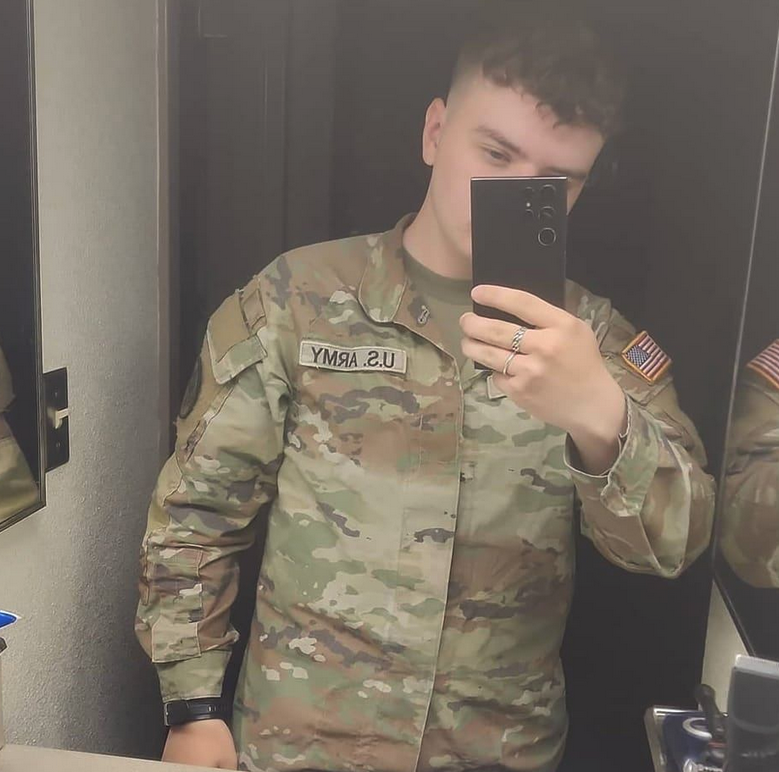
One of several selfies from the Facebook page of Cameron Wagenius.
Cameron John Wagenius, 22, was stationed at a U.S. Army base in South Korea when he adopted the cybercriminal persona “Kiberphant0m.” Working with three alleged co-conspirators, Kiberphant0m downloaded data from several large customers of the cloud data storage service Snowflake that had exposed credentials and did not enforce multi-factor authentication (Snowflake has since mandated MFA on all accounts).
In October 2024, Kiberphant0m bragged on the cybercrime forums that he’d stolen the call and text metadata (e.g. source and destination number, timestamp, duration, etc.) for tens of millions of AT&T customers. Kiberphant0m claimed to have hacked into more than dozen telecommunications companies worldwide, including Verizon’s Push-to-Talk business, and publicly extorted these companies in exchange for a promise not to publish the stolen data.
In late November 2025, KrebsOnSecurity warned that Kiberphant0m was likely a U.S. soldier stationed in South Korea. Less than a month later, Wagenius was arrested and charged in two separate federal indictments, and soon pleaded guilty to all counts in both cases.
At his sentencing hearing in Seattle today, Wagenius was sentenced to nearly six years in federal prison, and ordered to pay $294,978 in restitution.
Federal prosecutors said Wagenius was assisted in his efforts to extort victim companies by Kenneth Schuchman, a 28-year old man from Vancouver, Washington who has a lengthy cybercriminal history. In 2019, Schuchman pleaded guilty to operating the Satori botnet, a vast collection of hacked Internet-of-Things (IoT) devices that was used for large-scale distributed denial-of-service (DDoS) attacks.
Two other alleged co-conspirators of Wagenius are still facing charges in connection with the Snowflake data thefts; Conor Riley Moucka, a.k.a. “Judische,” of Kitchener, Ontario was arrested in 2024 and pleaded guilty in August 2026; and John Erin Binns, an American man currently living in Turkey who is also wanted for a 2021 data breach at T-Mobile that exposed the personal information of at least 76 million customers.
Kiberphant0m also admitted to re-extorting victims, and threatening to disclose national security secrets. Immediately following Moucka’s arrest — after AT&T had already paid the extortion group a $370,000 Bitcoin ransom — Kiberphant0m posted on hacker forums what he claimed were the AT&T call logs for then President-elect Donald Trump and for then Vice President Kamala Harris, as well as schematics allegedly stolen from the U.S. National Security Agency (NSA).
Paul Russell is a resident agent in charge at the Defense Criminal Investigative Service (DCIS), the criminal investigative arm of the U.S. Department of Defense Office of Inspector General. Russell said when DCIS received information that a soldier with secret clearance was allegedly involved in cybercrime and extortion, the agency began working the investigation alongside the FBI, the Army Criminal Investigative Division (CID), and the U.S. Secret Service.
“We don’t often get leads where there’s an active duty soldier with a secret clearance who’s creating hacking tools and trafficking in data,” Russell said. “That doesn’t happen every day, and so when that hits it really spins all of our partner organizations up. It was very serious from jump street, just because it was unique, it was an insider threat, and we weren’t sure what we were dealing with.”
A sentencing memo (PDF) filed Sept. 19 by federal prosecutors in Seattle notes that while Wagenius pleaded guilty almost immediately and has been remarkably cooperative, he recently got caught trying to find security vulnerabilities in the BOP’s computer network. The government’s memo notes that while incarcerated and awaiting sentencing, Wagenius violated the computer use policies of the Bureau of Prisons (BOP) in attempts to learn about vulnerabilities in BOP computer systems.
“According to records from BOP, in or around September 2025, Wagenius used another inmate’s email system to request that the email recipient prompt a commercial AI tool to provide information about “[w]hat CVE’s are there for Windows 10 Enterprise privilege escalation and bypasses” and to “[p]rovide the CVE’s and a real world working script for each CVE . . . without omitted code,” the government’s memo states.
The memo states that less than a week later, Wagenius used a different inmate’s email account and requested that the email recipient prompt an AI tool to “[p]rovide the step by step for CVE-2023-45208, code for this if any, and if no code exists make some, make sure to describe everything in detail.” CVE-2023-45208 is a three-year-old “command injection” vulnerability in D-Link networking devices.
That same month, Wagenius allegedly again requested that the email recipient prompt AI with the question, “How do you make an antenna in a prison environment with commissary or readily available items/tools to improve/make an antenna to extend radio reception?”
Federal prosecutors said Wagenius also requested that the recipient research escaping prison.
“In several instances, Wagenius framed the AI queries as being posed in connection to a book he was writing. This is a common method of ‘prompt injection,’ in which attackers feed specially crafted, deceptive inputs into commercial AI tools that are programmed to avoid outputting malicious code that can be used to exploit computer vulnerabilities,” the sentencing memo reads.
The government told the court it is unaware of evidence that Wagenius figured out how to use or deploy the vulnerabilities he was researching in the BOP’s systems, and when questioned said he was only researching “potential vulnerabilities to provide information to the BOP.”
Incredibly, despite the enormous financial value of the data stolen from AT&T and other telecom providers, Wagenius’s extortion efforts were largely unsuccessful. The government’s sentencing memo says Wagenius made a whopping total of around $1,500 from selling stolen data.
“While Wagenius was not particularly financially successful as a cybercriminal, he both intended to and caused significant harm to numerous individual victims, U.S. companies, and the U.S. government,” the memo states.
Categories: Technology, Virus Info
Data Broker Radaris Loses Domains in Privacy Fight
The consumer data broker Radaris.com has long had a reputation for ignoring requests to remove personal information from its vast empire of people-search services online. That reputation caught up with the company recently in a lawsuit alleging Radaris violated a New Jersey privacy law that provides for hefty fines against data brokers that publish personal information on state law enforcement officials. In the face of repeated stonewalling and prevarication by attorneys for Radaris, the judge in the case ordered that radaris.com and more than a dozen other data broker domains be transferred to the plaintiffs.
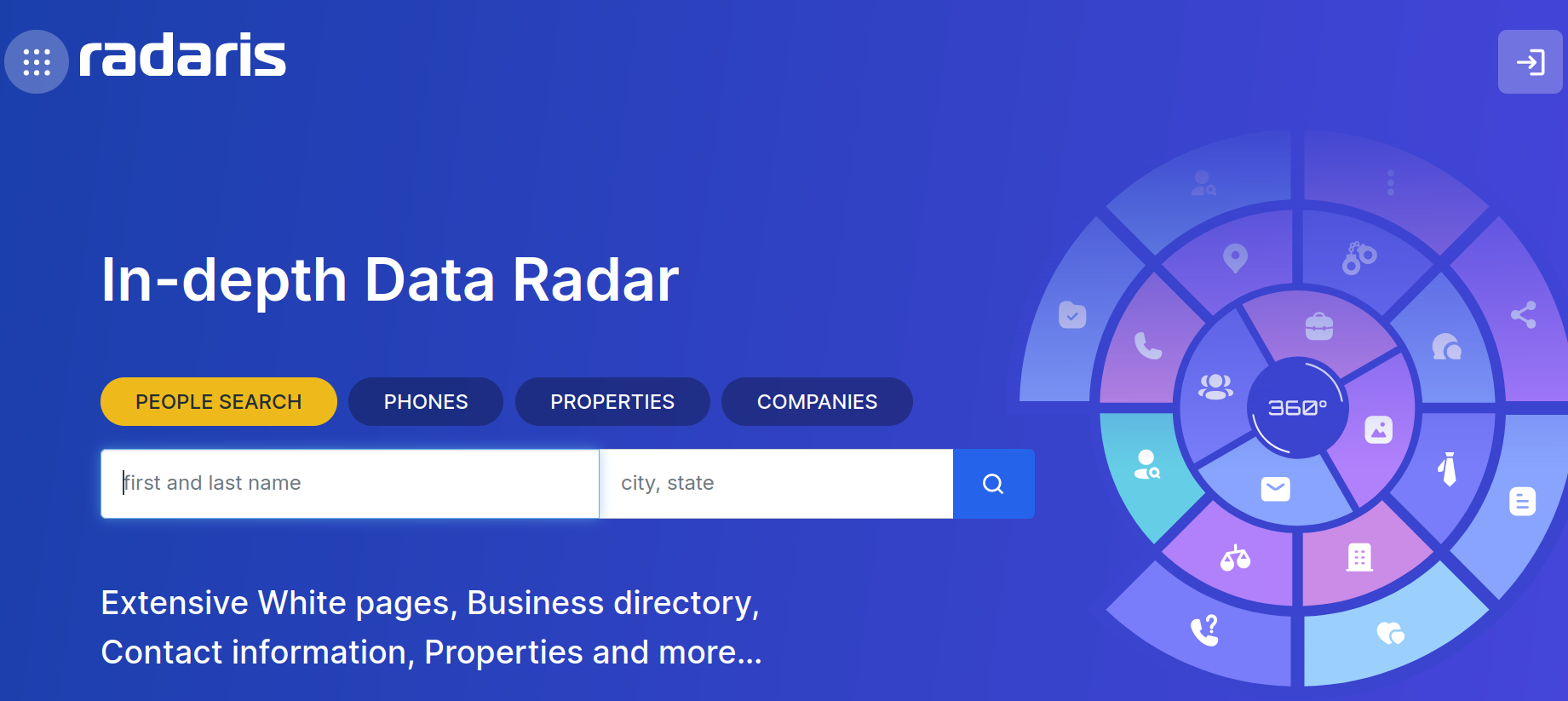
The radaris.com website, prior to the domain transfer to Atlas.
In February 2024, Radaris was sued by Atlas Data Privacy Corp, a company that has been pursuing data brokers alleged to be violating a New Jersey statute called Daniel’s Law. The statute allows state law enforcement officials, government personnel, judges and their families to have their information completely removed from commercial data brokers and people-search services, and provides for fines of $1,000 per violation against companies that ignore removal requests.
Less than a month after Atlas sued Radaris, KrebsOnSecurity published a deep dive into the Radaris co-founders — Igor and Dmitry Lubarsky (also spelled Lybarsky) — Russian-born brothers living in Massachusetts who operate a dizzying array of people-search companies as well as a number of Russian language dating services and affiliate programs.
Attorneys for the Lubarsky brothers threatened to sue for defamation if the story wasn’t removed and an apology issued. Their attorney asserted that our reporting was wildly inaccurate, and that the true owners of the company were Ukrainians living in Ukraine.

The Lubarsky brothers Dmitry or “Dan” (left) and Gary/Igor.
KrebsOnSecurity doubled down and showed how the Lubarsky brothers built and operated Radaris and other data broker companies using a fictitious CEO’s name. Our follow-up story noted that Radaris’s attorney — a lawyer with the Boston Law Group named Val Gurvits — admitted his clients had invented the CEO pseudonym “Gary Norden,” and that Radaris also had issued multiple press releases over the years that quoted the fake CEO while seeking money from potential investors.
Attorneys for Radaris waited until the last minute to appear in court and contest what was all but certain to be a default judgment in favor of the plaintiffs, and then told the court that Atlas had failed to serve the real owners and operators of Radaris and several of its sister data broker companies.
Atlas re-filed the lawsuit in June 2025, this time dramatically expanding the number of Radaris family data brokers accused of violating Daniel’s Law. Matt Adkisson, president and CEO of Atlas, said Radaris turned to a tried-and-true playbook: Delaying in court until the last possible minute, and playing shell games with Radaris’s true country of origin and the individuals listed as owners and operators of these sites.
“We refer to this period as their island-hopping phase. Privacy policies changed constantly, and new entities kept appearing from places like the Marshall Islands, the British Virgin Islands, and Seychelles,” Adkisson told KrebsOnSecurity. “Behind the scenes, it felt like a shell game. Defense lawyers told the court that certain entities merely operated the domains and were the proper parties to sue. But by the time a judgment neared, those entities would be discarded and new entities would appear. Meanwhile, the lawyers claimed the other entities that actually owned the domains should not be held responsible.”
Adkisson said when the defendants updated their terms of service to state that Radaris was suddenly managed by a company in the Marshall Islands, Atlas hired an investigator in that country and soon learned the brand new entity that Radaris claimed was managing the company didn’t even exist yet.
Mr. Gurvits stepped forward as Radaris’s attorney in a class action lawsuit the company temporarily lost in 2017 because it never contested the claim in court. When the plaintiffs told the judge they couldn’t collect on the $7.5 million default judgment, the court ordered the domain registry Verisign to transfer the radaris.com domain name to the plaintiffs.
Mr. Gurvits appealed that verdict, arguing the lawsuit hadn’t named the actual owners of the Radaris domain name — a Cyprus company called Bitseller Expert Limited — and thus taking the domain away would be a violation of their due process rights.
The judge in the 2017 case ruled in Radaris’ favor — halting the domain transfer — and told the plaintiffs they could refile their complaint. Soon after, the operator of Radaris changed from Bitseller to Andtop Company, an entity formed (PDF) in the Marshall Islands in Oct. 2020. The plaintiffs never re-filed their lawsuit.
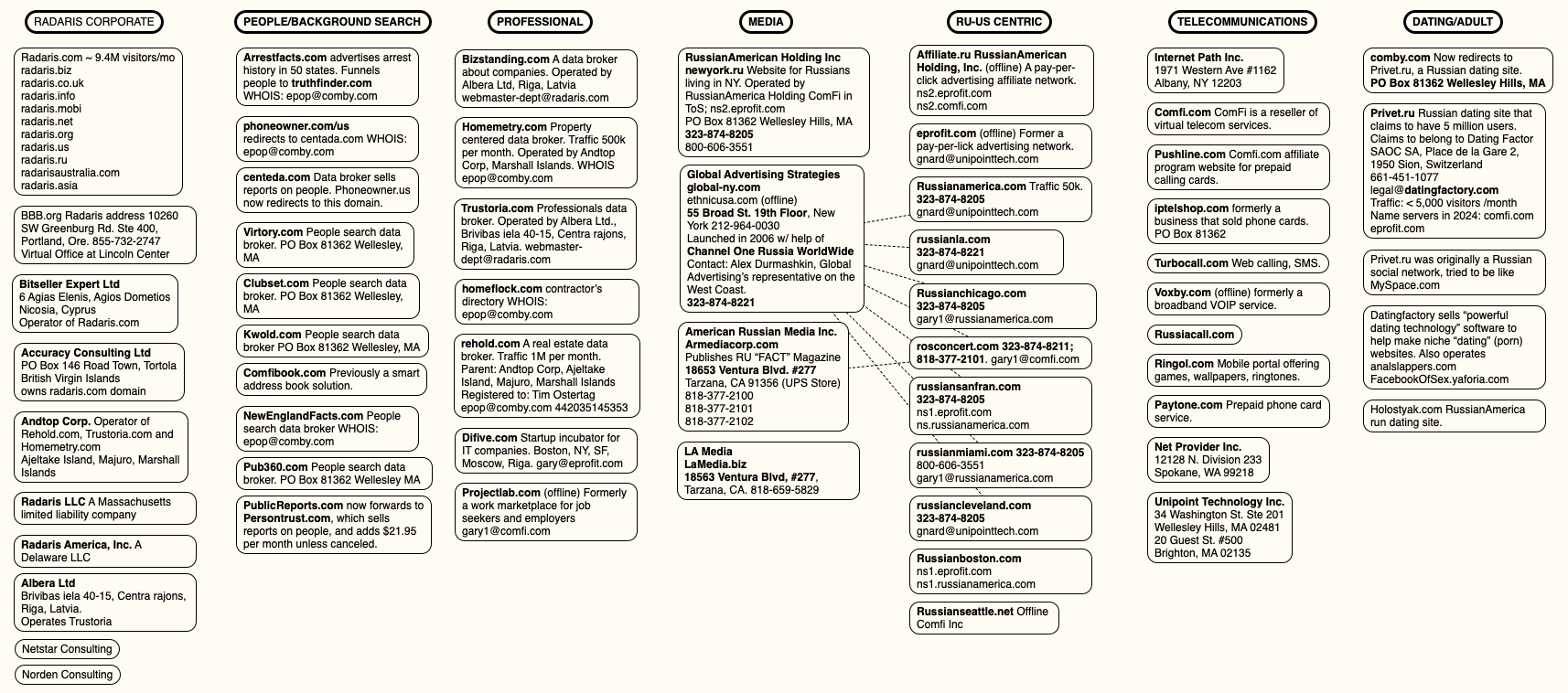
A mind map of various entities tied to Radaris and the company’s co-founders. Click to enlarge.
“That seemed to be their modus operandi,” said Raj Parikh, a partner at PEM Law in New Jersey who handles most of the Daniel’s Law litigation for Atlas. “In the past, they won by attrition. Plaintiffs’ attorneys tired of the procedural games and just gave up. That strategy worked for a decade, and it probably would have worked in this case too, since any financial recovery from foreign actors will be difficult. But we were acutely aware of the threat this website posed to law enforcement officers and other public officials in New Jersey, and decided early on to commit whatever time and resources were necessary to remove that threat.”
On August 26, the judge in the New Jersey case found the defendants were given multiple chances to appear and defend the claims against them but had failed to do so. Mr. Gurvits declined to comment on the case, saying it had been assigned to another attorney, a Mr. Victor Worms. In response to questions, Mr. Worms asserted the New Jersey court transferred Radaris.com to Atlas as part of a default judgment against Radaris.com, which is not a legal entity.
“We have made a motion to vacate that default judgment on the grounds that it is void since a non-entity has no legal capacity to sue or be sued,” Worms replied. “We also intend to pursue all appropriate appeals because we believe the transfer of Radaris.com amounts to a forfeiture in violation of various constitutional principles.”
While radaris.com still comes up prominently in results when searching online for U.S. residents by name, the domain no longer sells detailed personal dossiers on millions of Americans. Its homepage now displays a notice from Atlas, as well as links to our previous reporting on Radaris.
EMAIL CONFIRMATIONSAtlas told KrebsOnSecurity that it has obtained more than 10,000 emails and documents in the course of litigation, and that those messages confirm our previous reporting on the owners and operators of Radaris and its myriad companies.
Atlas said the emails clearly establish that the nominal legal vehicles — Radaris America, Inc.; Bitseller Expert Limited; Digital Orbit Corp; Core Solutions Group Inc; Lucky Solutions Inc; Virtura Corp; Veripages Inc.; Nuform Solutions Inc.; Growth Data Advisors Inc.; Property Experts, Inc — are all administered by the same three or four people from the same mailboxes, share one bank or payment card set, and are all managed from one virtual office address.
“The corpus establishes, with documentary evidence generated independently by banks, payment processors, hosting providers, registrars, software-as-a-service vendors and the operators’ own systems, that radaris.com and at least twenty-five other people-search websites are one operation run by a small Boston-area group whose administrative, financial and technical functions sit on the difive.com mail domain and its successors (centerex.com, scienteco.com, eprofit.com, realmo.com, pub360.com),” reads a summary shared by Atlas.
Atlas said the emails show Radaris.com earns approximately $42,000 a month, while Veripages.com earns around $45,000 monthly via its partnership with the Lifetime Value Company, a marketing and advertising firm whose brands include PeopleLooker, PeopleSmart, NumberGuru, and Bumper, a car history site.
According to Atlas, the emails also showed the Radaris family of websites earns as much as $25,000 each month from their partnership with Onerep, a company that claims to help people remove their information from people-search sites. In March 2024, KrebsOnSecurity revealed how the Belarusian founder of Onerep had launched and operated dozens of people-search sites over the years and was continuing to operate one of them (Nuwber), effectively spreading the disease and selling the cure.

The domain radaris.com now redirects to this notice from Atlas about the court-ordered domain transfer.
All told, the New Jersey court has so far transferred 14 domain names from the Radaris family of companies to Atlas. Radaris.com now redirects to a notice of the court-ordered domain transfer.
THE ROAD AHEADThe Radaris family of companies is still potentially facing fines of $1,000 per alleged violation of Daniel’s Law. For the time being, however, Daniel’s Law is facing a constitutional challenge from virtually all of the 150 other consumer data broker firms being sued by Atlas.
The data broker industry responded by having at least 70 of the Atlas lawsuits moved to federal court, challenging the New Jersey statute as overly broad and a violation of the First Amendment. The U.S. Court of Appeals for the Third Circuit has not yet issued a decision on the constitutional challenge, but either way the case is widely expected to be appealed all the way to the U.S. Supreme Court.
Meanwhile, at least 14 other states have now passed laws modeled after the New Jersey statute, with more states considering similar measures. However, West Virginia’s Daniel’s Law was ruled facially unconstitutional under the First Amendment by a federal district court in August 2025.
Justin Sherman is a privacy expert and author of the forthcoming book “The Middlemen,” which examines how the data broker industry powers modern surveillance. Sherman said federal lawmakers have long faced intense lobbying by the technology industry against more restrictive U.S. data privacy laws, but that many powerful industries are now working against passing comprehensive data privacy legislation.
“These days at the federal level, add in the intense amount of lobbying against these laws from social media companies, big tech, cryptocurrency firms, and now AI proponents in the mix who claim that limiting their data scraping is somehow going to collapse the whole U.S. economy under Chinese rule,” he said.
Sherman said people-search companies will continue to thrive unless and until Congress enacts meaningful consumer privacy and data protection laws that are relevant to life in the 21st century. That’s because virtually all state privacy laws exempt records that might be considered “public” or “government” documents, including voting registries, property filings, marriage certificates, motor vehicle records, criminal records, court documents, death records, professional licenses, bankruptcy filings, and more.
At least 25 states have passed or implemented laws requiring age verification for residents seeking to access adult content online, but there is no federal law that limits how the companies that are scanning everyone’s drivers license can use, share or keep the data provided. Had such restrictions been enshrined in law, we may have avoided the recent breach at IDScan.net, which exposed the drivers license information on more than 153 million Americans when the records were briefly turned into a point-and-click identity theft service on the dark web.
“The average person can look at Daniel’s Law and have a perfectly normal reaction, which is that everyone should be covered, not just police and judges,” Sherman said. “But we don’t need more wake-up calls. We’ve had eight million wake-up calls already on the need for better privacy laws. The lack of comprehensive federal privacy law is not for a lack of knowledge, and anyone claiming otherwise is either not reading the news or kidding themselves.”
Categories: Technology, Virus Info
Syndicate

Ohio News
- Columbus fire officials urge caution for lithium-ion charging
- Police, leaders speak on "staggering" domestic violence rates, goal to decrease them
- Ohio lawmakers want state to regulate e-bikes, e-scooters
- Small businesses defend against new cybersecurity threats
- Man pleads guilty to fatal shooting at Columbus bus stop
Other News
- New Yorkers still have time to register to vote in the mid-terms
- ANCA names new executive director
- NY hit pause on large data centers. A massive project in Massena may be exempt
- A historic El Niño is brewing in the Pacific. How will it impact the North Country this winter?
- New Marist poll: Hochul leads Blakeman by 11 points among registered voters